Challenge Source
p = random_prime(2**1024)
q = random_prime(2**1024)
a = randint(0, 2**1024)
b = randint(0, 2**1024)

def read_flag(file='flag.txt'):
    with open(file, 'rb') as fin:
        flag = fin.read()
    return flag

def pad_flag(flag, bits=1024):
    pad = os.urandom(bits//8 - len(flag))
    return int.from_bytes(flag + pad, "big")

def generate_keys(p, q):
    n = p * q
    e = 0x10001
    return n, e

def encrypt_message(m, e, n):
    return pow(m, e, n)

flag = read_flag()
m = pad_flag(flag)

n, e = generate_keys(p, q)
assert m < n

c = encrypt_message(m, e, n)

print(c)
print(n)
print(p + b^2 * q)
print(a^2 * p + q)
Idea
Well, this is just classic RSA encryption. On its own, this scheme is definitely not breakable. However, the author provides some additional values so that somehow, we can use them to decrypt the encrypted value :
where , is some random value .
My teammate immediately recognized (god 😢) that:
For which you can reason it by doing the following calculations:
Let's set to be .
If is small enough to and , we can approximate it to be
Since and their reciprocals involve in the sum making up , the bigness of depends on and . And you can reason that for any two numbers generated at random in the same interval, the ratio is expected to be small.
During local test, I realized that is very small (like, or or something...). In fact, let's plot for different values of and see how it goes 🙂
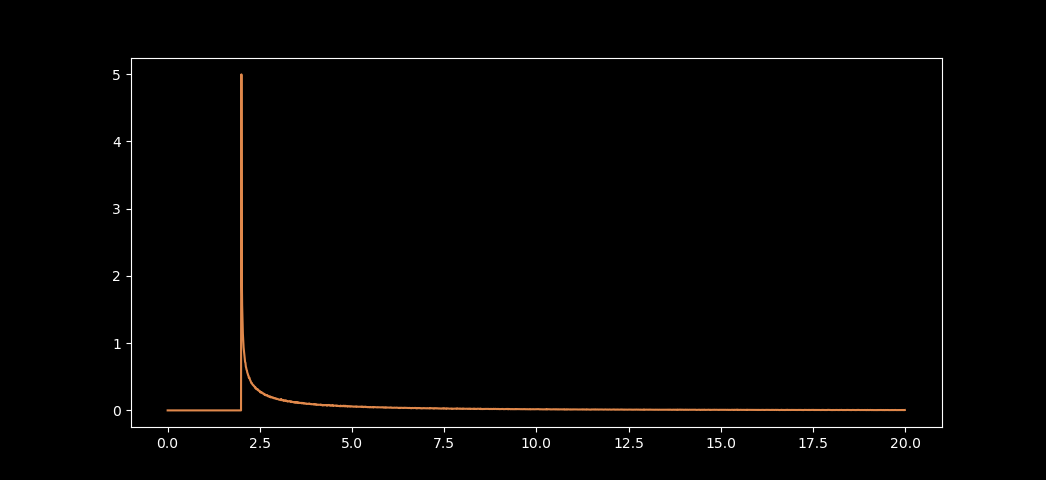
The left column represents the percentage of occurances for a certain . And you can see for ALMOST ALL cases, will just land around on some value . (yes, while you can argue that the spike of is just 5%, so the rest could be much bigger, however, the probability of landing is just 12%)
Also, you can notice that the plot is flat before a sudden spike around . This happens because can be represented in the form of , and from AM-GM Inequality, for any .
Anyways, this means in most cases, we can expect:
or if you are really skeptical, you can bound it to be , just to be sure 🙂 This means that we can find just by bruteforcing 10000 values around .
Get
Knowing , we now have 4 equations with 4 variables to solve:
for which we can lend the power of magic Sagemath to solve for .
from sage.all import *
from tqdm import trange

c = ...
n = ...
h0 = ...
h1 = ...

P = PolynomialRing(QQ, names=('b', 'q'))
b, q = P.gens()

ab_approx = Integer(isqrt(Integer(h0*h1) / Integer(n)))
for delta in trange(0, 1000):
    ab = ab_approx - delta

    # Here, I substitude a*b = ab and p*q = n
    # to reduce number of equations & vars
    eqs = [
        n + b**2 * q*q - h0*q,
        ab**2 * n + q*q * b**2 - h1 * b**2 * q
    ]

    # Copied from somebody's Coppersmith multivariate solver :v
    H = Sequence(eqs, P)
    I = H.ideal()
    if I.dimension() == -1:
        H.pop()
    elif I.dimension() == 0:
        for root in I.variety(ring=ZZ):
            print(root)

# q = 109813633407350440684752357104087423730270808390261227637462376676953120335377705330415425210793126533507813859480119893163026376723863463313335381388502153679899248105338398482841127131263152039296390164162491463575378945424202721526857339615769738614581032689687091169497613753054146273393581209744585087263
Get Flag
Since we have , we can now recover the private exponent and solve for flag 🙂
from Crypto.Util.number import *

c = ...
n = ...
h0 = ...
h1 = ...

e = 65537
q = ...
p = n // q
d = pow(e, -1, (p-1)*(q-1))
print(long_to_bytes(pow(c, d, n)))

# b"midnight{1_kN0w_3n0ugh_4b0ut_RSA}\n\xa9\xbd\xd17\xec'\xed\x9c\x19RD\x8f\x9c8\xe4\xb9\x11\xf3\xb5/\xdeC\xff\xe5c\x89_3\xd7F\x1f^\x12 +A\xc3\xc7\\HC\xd9!\xd6`\x86\xa8B\xc0A)4q\x85x<\xbd\xe7@\xa9\xa3\x08\xc2\xb0\xdf\x03\xb9\xbd.\x8f\xa3\xe5\xd8\x8b\xf0\xadw7\xb7\xe1\xa2j\x95\xd9\xe5!\xee\xf2u\xf32\xf1V\x1c"